Thursday, 10 February 2011

Puerto Montt and Valparaiso

After a bumpy night in the Pacific Ocean we reached the shelter of the fjords again after lunch and enjoyed the views from our sun bed on the Promenade deck although the air temperature was still only 12C. Come Sunday morning we woke to find Aurora anchored off the town of Puerto Montt and ready to take us all ashore by tender. It was a cold overcast morning but we were ashore soon after 1000hrs. The town is the capital of the Tenth Region of Chile and the centre of the Lake District but we had decided that we did not want to spend the day on the road so just opted to walk around town. With hindsight this was probably the wrong decision as it was Sunday and only the supermarkets and a large shopping mall were open.
  The city which now has a population of 175,000 was first settled by German immigrants in 1852 and there is a bronze memorial to the first 200 on the seafront. The city is named after Don Manuel Montt, President of Chile from 1851-61. It is a modern but untidy city, largely rebuilt after a catastrophic earthquake and tsunami in May 1960 which destroyed much of it. It lies on the same latitude as Wellington, New Zealand.
  After walking around the city centre and visiting the Cathedral while a service was in progress we replenished our supplies and ended up returning to the ship just as the sun was breaking through. Later that afternoon we were resting on a sun bed on Aurora´s classic stern area when the last of the cloud evaporated to reveal the most fantastic view of the two nearby volcanoes, Calbuco the largest and nearest and also Asorno, likened to Japan´s Mount Fuji and completely snow covered. These volcanoes made a wonderful backdrop as we sailed away later that afternoon on our way north towards Valparaiso where we will spend the day on Tuesday.
  On that morning we were up before sunrise to find Aurora already alongside a container berth in a port surrounded on 3 sides by high hills that were heavily populated. It is known as the city of 42 hills and has a population of over 300,000. We had taken the advice of a friend to explore the Chilean capital Santiago rather than Valparaiso (Vale of Paradise) so had soon boarded our tour bus for the 2 hour journey inland. Santiago is a sprawling city, the largest in Chile and has one third of the country´s 20 million population. The morning had started grey and cold so we had taken warm gear with us but we need not have worried as no sooner had we climbed over the port hills than the cloud evaporated and the sun shone. It was a fascinating drive, initially over the port hills and down into a fertile valley where many major vineyards produce wonderful white wine. There were 2 major tunnels, one over 3km long and more hills which resembled those in southern Spain until we entered the outskirts of Santiago.

  As we were `on your own` our guide drove us around the centre, showed us where to meet at 1500 and then took us to the base of the mountain where the statue of the Virgin Mary stands in Metropolitan Park. We rode a funicular railway up the steep track to the top and enjoyed the wonderful views and restful music playing there. As time was limited we made our way down by 1300 and walked through Barrio Bellavista,(the two ls are pronounced as js here!) the lively and Bohemian Paris Quarter of the city. We would have loved to be able to visit at night! On across the river (not impressive) to Plaza Italia
and along wonderful parks with so many statues and back to Plaza de Armas at the city centre. Here was the cathedral, many museums and government buildings. Interestingly the parliament is meeting in Valparaiso at present due to earthquake damage to the building in Santiago. We explored for a bit and enjoyed the feel of the city but by then it was 30C so refreshments and a snack was called for and we found a pavement café in the square to watch the world go by. 1500hrs came so quickly and it was time to reboard the bus to the ship.
  Back in Valparaiso at the terminal at 1730 we decided to walk the short distance into the local centre but found it dirty and did not possess the grandeur of Santiago. Later we were told we missed the best bit which was the old town but as this was such a long walk from the terminal (and no shuttle buses) we did not find it. (The port guide was pretty poor!
  We returned to the ship for dinner, as we found nowhere suitable in the city and enjoyed a wonderful sailaway after 2300hrs as all of the lights of the city slowly disappeared into the distance. Goodbye South America - we have thoroughly enjoyed our visit and hope to return someday! We have ahead of us 8.5 days on board until we touch dry land again in Tahiti. Back into our sea routine and good weather we hope!
  P.S. Thanks to everyone who has commented on this blog.

Saturday, 5 February 2011

Ushuaia,Punta Arenas and the Chilean Fjords and Glaciers

  After leaving Ushuaia and admiring its situation nestling among the snow capped mountains, we headed south again and soon joined the Beagle Channel, named after HMS Beagle with Captain Robert Fitzroy in command. He led a surveying expedition to Patagonia and Tierra del Fuego in the 1830´s accompanied by a young Charles Darwin.
Heading west along this narrow channel the weather worsened to a force 8 headwind with rain so we withdrew to our cabin to watch the passing landscape from our sheltered balcony. In between the mountains we passed 3 notable glaciers, the first we had ever seen. These apparently were nothing special but we thought they were awesome and commented how blue the ice was.
  Next morning early Aurora dropped anchor off Punta Arenas (Sandy Point) our first port in Chile and the southernmost city on the South American mainland. It used to be one of the busiest ports in the world when operating as a coaling station for ships going around the Horn but this stopped abruptly in 1914 when the Panama Canal opened. Capital of Magellan´s Province the city of 120,000 people has a relatively dry climate but suffers incessant winds in the summer months. 18C is apparently a high temperature and not often achieved. We had about 12C with a considerable windchill.
  We were ashore soon after 0900 on our tour, and were taken inland and up the mountain in our coach. The roads were unsealed as soon as we left the city and as we climbed higher the views across the Straits of Magellan became magnificent. At the Ski Centre (no snow!) we all transferred to the chairlift to go higher and it was so cold! The wind blew right up our trouserlegs! From the top we started our trek down the mountain and through the forest-very steep in places and quite muddy on occasions. It was slow going because of the back stragglers but we made it back to the Ski Centre in one and a quarter hours. We were then rewarded with hot chocolate and cake. Great!
  We were then taken back into the city and dropped in Plaza de Armas, the main square to roam around on our own. This square has a wonderful central bronze statue of  Magellan and at one corner of the Plaza is the impressive Hotel Jose Nogueira, once the home of one of the city´s wealthy matrons, Sarah Braun. Apart from the Town Hall and some museums, the rest of the centre was architecturally disappointing so we shopped for our fridge magnet and for some local wine in the supermarket and returned to the ship for lunch. At 1700 the tenders were recovered, the anchor was weighed and we set off north towards Puerto Montt . We don´t reach it until Sunday when we hope it will be warmer! On the way we will be viewing at least 2 major glaciers.

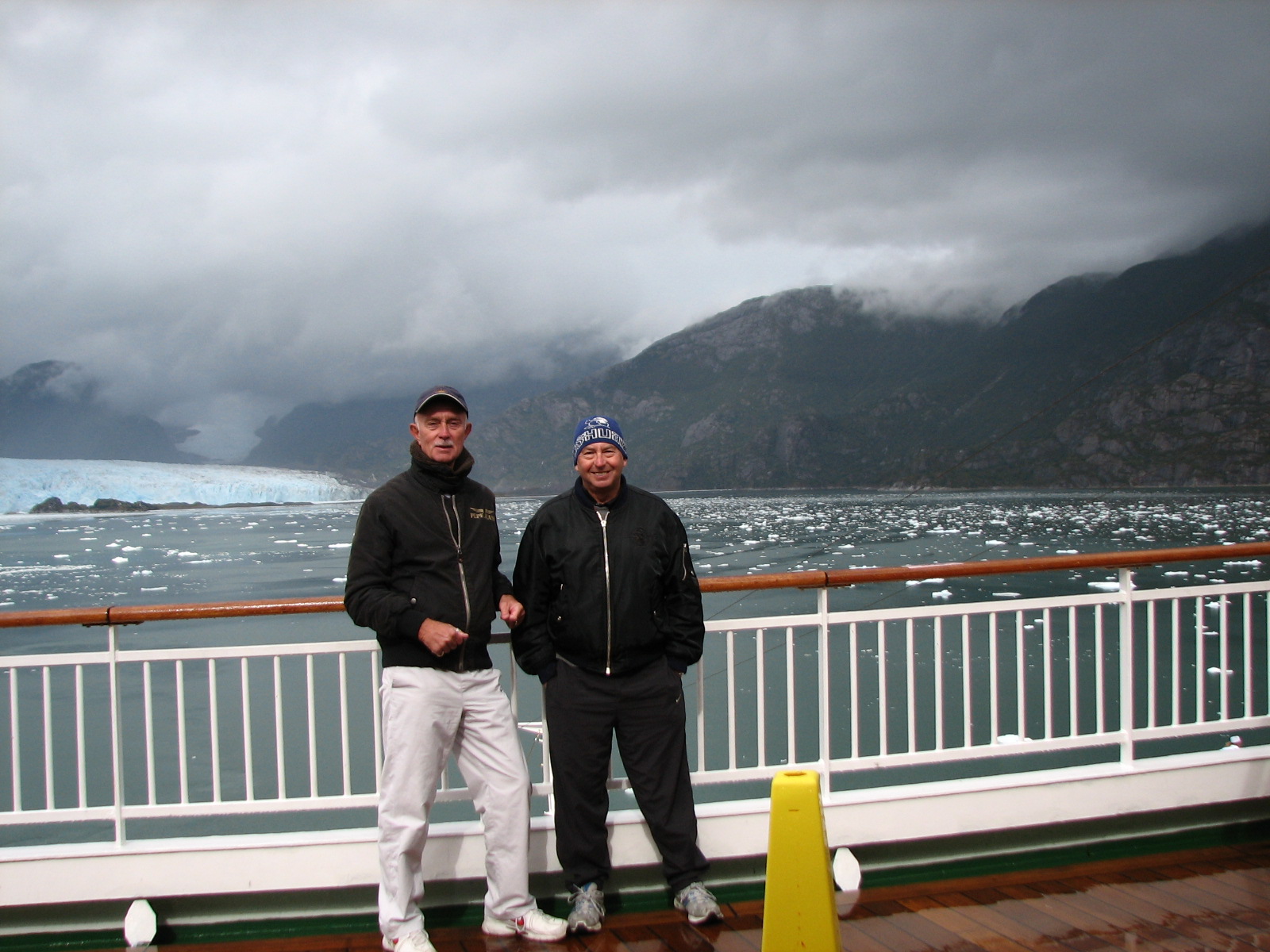
  The next morning we were still surrounded by mountains but returned to our normal sea routine, even our walk-only 3 miles today because of the cold! Later on in the afternoon we slowed as we approached the Amalia Glacier and entered floating ice before stopping less than a mile from this amazing wall of ice. This glacier is retreating slowly and talking to someone who saw it 4 years ago it has indeed moved back significantly. Aurora turned round completely and sat there for about an hour as we admired this wonderful natural phenomena. The sun appeared occasionally to light up the ice and would then disappear as the rain passed over again. We noted that the sea temperature was only 6C!

  Later that evening we entered another arm of the fjords, saw a number of seals and viewed another glacier, the Bruho Glacier, not quite as impressive as Amalia, just somewhat smaller but here the sun did not shine for us.
  After another night navigating between the mountains we were awoken by the Captain at 0800 saying we were approaching the Pio XI Glacier, the largest one outside Antarctica. Well wrapped up we ventured outside into the driving rain to see this magnificent sight ahead of us. This glacier´s ice face was at least 30 metres high and 2.4 miles across the side of the fjord. We were told it also extends over 40 miles back from the sea. Awesome! There was hardly any sea ice here so the rescue boat was lowered to take a ship´s photographer away to take photos of the ship with the glacier. Apparently this glacier is still growing every year-I wonder how the global warming lobby explain this!
  After an hour here Aurora turned round and headed back down one magnificent fjord after another for the rest of the day. Despite the rain it was so wonderful. As a respite from all these great sights we spent 45 minutes at 1400 listening to a popular classical concert in the theatre given by our resident pianist for this leg, Julian Jacobson.
Cruising does give you so much impressive choices!
  Late afternoon saw us reaching the Pacific Ocean again and a 4m swell and turning north towards the warmer weather. Saturday  morning we regain the shelter of the fjords that the Chileans call canals, ready for our next port on Sunday, Puerto Montt.
 

Wednesday, 2 February 2011

The Falklands, Cape Horn and Ushuaia

On Sunday 30th we awoke early to find that we had already anchored in a calm and peaceful Port William which was a 20minute tender ride away from Port Stanley town.
The weather was cold and drizzly but that was what we expected!
   The first explorer known to have landed on the Falklands was Captain John Strong in 1690 and he named the stretch of water between the two main islands Falkland Sound after Viscount Falkland a British naval official. The Falklands comprises an additional 700 smaller island too and are situated 300miles from Argentina and 8000miles from the UK. Port Stanley is on the same latitude south of the equator as Watford is to the north. The British first claimed sovereignty in 1776 and then Argentina did in 1820. Argentina did not try to take possession until 1982 and we all know what happened then.
  We chose a morning tour to see the penguins so were tendered ashore where we boarded mini buses for a 20 minute journey along rough un-sealed roads to a rendezvous point with several 4x4´s (Landrovers of course). We noted on the way that large swathes of land are still fenced off with signs warning of mines! Also that much of the land is peaty and rocky and quite unsuitable for cultivation. Our Landrovers took us on another 20 minute journey off road (but mine free!) across the very uneven terrain at slow speed thankfully. It was very very rough going but we eventually made it to Bluff Cove Farm and a large colony of penguins sitting close to the shore. There the sun came out and it was glorious! There were some King Penguins but mostly Gentoo Penguins and most were youngsters as the parents go searching for food during the day. It was fascinating just seeing them in their normal habitat-some were playing in the sea too.
  Having taken too many photos we retreated to the Sea Cabbage Café where we had coffee and some lovely homemade cakes and listened to a girl playing the concertina, all included in our fare. Then next door to the museum, recently opened where there was more live music, a guitarist this time and the opportunity to buy our fridge magnet. The white sandy beach and blue sea looked quite Caribbean like in the sunshine.
  Our 1 hour there was soon over and we reboarded our transport for the hairy journey back to the main road and to Port Stanley. Everyone was very satisfied with a terrific trip.

  Dropped off in Port Stanley we walked about in the sunshine and visited several of the shops, Christ Church Cathedral, Victory Green where the original mizzenmast of the Great Britain is to be seen, the 1982 Liberation monument, the 1914 Battle memorial and we walked past Government House. We wrote a card here and posted it to Mars (see photo)-I wonder how long it will take to get to Estepona!  Then it was time to relax so we visited two of the local pubs, the Victory and the Globe but no draught beer only bottled as there is no brewery on the islands now! It was fun but the pubs reminded us of the scruffiest pubs in Gibraltar!
  It was soon time to join the long queues for the tenders back to the ship after an amazing day in the Falklands. Sailing out of Port William around 1830 was magical as there was no wind and small Magellanic Penguins could be seen swimming away from the ship and avoiding our massive bulk. Clear of the islands we headed South West ready to round Cape Horn on the following day.
  On Monday afternoon, with the weather so predictably correct, in other words bitterly cold at 7C with a biting gale force westerly wind and passing rain showers, we approached Cabo de Hornos and passed it around 1700hrs.Our most southerly point was exactly 56 degrees south latitude. The massive cliffs and rugged rocks were so impressive and brought home to us how dangerous this part of the world must have seemed to those intrepid sailors of yesteryear in their small sailing ships. The lighthouse there is so remote and actually manned by four people! We got so cold admiring the view from our cabin balcony but it was so worth it. A friend who was watching it with us (she has an inside cabin) only had flipflops on her feet and was almost frostbitten! Later that evening we had our predinner drinks in the Crows Nest Lounge (another dress night!) as we proceeded north with mountains on either side towards our next port of call Ushuaia in Argentina, It was an amazing sight.
  In the early hours of the morning we berthed alongside in Ushuaia, the capital of the province of Tierra del Fuego, a city with a population of only 45,000. It is on the same south latitude as Sunderland is in the north and claims to be the most southerly city in the world. The city and port is well used as a stopping off point for Antarctica and derives most of its income from lumber, fishing and tourism. The surrounding mountains still had a considerable amount of snow on them and looked gorgeous when the sun occasionally broke through. We had not organized any trips so explored the town, visiting many of the souvenir shops with ´end of the world´ merchandise, bought our fridge magnet, had our coffee fix (no Macdonalds here just like the Falklands!), climbed as high as we could to get the views and ended up in an Irish Bar that had no Guinness!!
  We enjoyed our stroll around but this was a short visit as at 1500 we were on board and on our way again. Tomorrow we visit our first port in Chile, Punta Arenas and we will be tendering in the cold! We are told we will be passing some glaciers this evening and we are going to be well wrapped up for that!

Saturday, 29 January 2011

Montevideo and Buenos Aires

  On Tuesday 25th we berthed in Montevideo on a clear and very warm morning. This was one of the very few places where we could leave the ship and walk straight into the city in a very few minutes.
  First impressions were of a clean and well ordered city with many similarities to cities in Spain. In fact the 1.8m inhabitants (half of Uruguay´s population) are almost entirely of European descent, mainly Spanish and Italian stock and the country is only the size of England and Wales. It is sometimes called the Switzerland of South America because of its high standard of living and its unique welfare state.
  We spent 4 hours wandering round the streets and admiring the sights as it got hotter-a maximum of about 32C. The main centre was the grand Plaza de  Independencia with Government house and its Opera House the Teatro Solis. We had to have a coffee break in a wonderful leafy square with a gorgeous fountain and ended up for a lunch break near the ship in the wonderfully restored Mercado del Puerto which is no longer a market but a collection of restaurants mostly serving barbecued beef. We came across our friends Mick and Mavis there and had to join them and sample the local beer which arrived in a 1 litre bottle named Patricia! Also a couple of huge barbecued sausages that were delicious!
  On the way back to Aurora we passed by some relics (an anchor and a gun rangefinder) salved from the German battleship Graf Spee which was scuttled outside the port in 1939.
  By 1730 everyone had returned aboard and we sailed away for the 125mile crossing of the Rio de la Plata to Buenos Aires.
  On Wednesday morning we arrived in the city of Buenos Aires, capital of Argentina and home of the tango. Cleansed by overnight rain we were lucky that the next 2 days would be dry and very warm and allow us to explore this famous city.
  The current city originated from a Spanish settlement in May 1580 named Nuestra Senora Santa Maria del Buen Aire. The city declared itself independent from Spain in 1810 and became capital of the United Provinces of Rio de la Plata 6years later. By the beginning of the 20th century the city had grown in size to nearly 700,000 and 70% of these were immigrants from Europe. Nowadays greater Buenos Aires has a population of over 13 million, more than a third of Argentina´s total and it certainly has the feel of a very large city. Argentina is 11 times the size of the UK and is on the same latitude as Adelaide.
  Argentina is of course famous for President Juan Peron and his wife Eva who reigned 1946-1955, for the Tango and for being the beef rearing and eating capital of the world. The period they want to forget is 1976-83 when the military appointed General Jorge Videla as President and anyone who opposed him was killed or just disappeared. In 1982 the failed invasion of the Falklands resulted in his downfall and things have improved ever since. Was it coincidence though that there was no BBC or Sky News on the ship´s TV while we were there?
  As there is no cruise ship berth we and the other 2 ships (4 on the next day) were berthed on the container terminal and shuttle buses had to take everyone to a new reception terminal where we transferred to shuttle buses taking us into the city. At times the queues were horrendous as you can imagine. However we made it OK and started our exploration of this very crowded and busy city at the Marriot Hotel and made our way along Avenida Florida, a pedestrianised shopping street where we were immediately accosted by street sellers offering Tango shows and dinner. This must be such big business. Avoiding them was fun and after much walking we arrived at the Plaza de Mayo which is the sight of the original settlement and also of the Casa Rosada where the Perons lived. There was a political rally going on there so many police in riot gear were in the background and firecrackers were being set off. We explored the Cathedral there as well before having a coffee break at a pavement café on Avenida 9 de Julio, a grand avenue based on Paris´s Champs Elysees. The city was certainly impressive and we enjoyed our trek and ended up  sitting outside an Irish Pub with a pint!
  Back on board mid afternoon we needed a rest and then prepared ourselves for our 7pm muster to go to a Tango dinner organized form the ship. This really was a highlight of the trip so far. First a 3 course meal served perhaps a little too fast for our liking but of excellent quality including a massive steak cooked to perfection. The wine flowed freely too! The restaurant was decorated like a wine cellar with a stage at one end and as soon as the meal was cleared the show began and continued for about 90mins. There was a five piece orchestra including a wonderful squeeze box, 4 elegant couples who danced some wonderful tangos, 2 solo singers and a couple of soloists, one who played an instrument called a Charanga I think, a bit like a mandolin. The other is difficult to describe but there were hard balls on the end of his ropes and he twirled these around and over his head and hitting the balls on the floor in time with the music-it was amazing. The show was over all too quickly to a standing ovation and we were whisked back to the ship by about 11pm.
  Luckily the straddle carriers´ warning sounds stopped during the night so we were well rested and up early on Thursday, beat the rush and were in the city for an open top bus tour at 1000. We started off by covering some of the city we walked to the day before including the main square where shrapnel damage to one of the government buildings was pointed out. This occurred when Peron was overthrown. We continued past grand buildings through areas called Monserrat and San Telmo and ended up not far from the football stadium at La Boca, the home of Boca Juniors. A little time was spent there in the many souvenir shops-very arty too and reminiscent of Camden Market. We returned to the city via Puerto Madera which is the old port area where warehouses have been restored and skyscrapers built. This was very impressive. Many great restaurants there too but no time to try them! The trip lasted 2.5 hours and unfortunately we felt there was no time to do another loop before our 4pm deadline so had refreshments before returning to the ship without queuing!
  Two days were good in Buenos Aires but not enough. About 1730 we drew away from the quay and headed out into the River Plate and turned south towards Port Stanley in the Falklands another 2 days steaming away. It was 30C today and expect it to be only 12C there so out will come the woolies again!    

Monday, 24 January 2011

Aurora 2010 Recife to Rio de Janeiro

  Our 2 days steaming south from Recife was idyllic! Hot sunshine and smooth seas-just what the doctor ordered. We were so looking forward to our next port of call, Rio as we had read so much about it but never been there before. We were not to be disappointed!
  Rio de Janeiro was named by Portuguese navigators who found it in January 1502 and assumed it was a river estuary (River of January). 60 years later the area was settled by the Portuguese and sugarcane plantations were set up. Slaves were imported from the Caribbean to work on the land and this explains the presence of many black people there today.. In the early 1700´s settlers from Europe arrived to exploit the newly discovered gold and diamonds and in 1763 Rio became the capital of Brazil. By the end of the 18th century the sugar industry faced much competition and Rio lost much of its prosperity. Luckily they started growing coffee and the rest is history!
  In 1889 the Portuguese monarchy was overthrown and Brazil became a republic. In 1960 the capital city became Brasilia specially built in the centre of this vast country which is 35 times larger than the UK and which covers nearly half of South America. Rio is on the same latitude as Rockhampton in Queensland Australia and has a population of 7m people (Sao Paulo has 17m!).
  With only one day in the city (0800-2300) we realized that we would not be able to see everything so we opted for a full day tour which visited the top of  Sugarloaf  Mountain and also the Statue of Christ the Redeemer which was erected in 1931 to celebrate 100years of independence from Portugal (1822).
  The approach to Rio in the morning (0600!) was spectacular as the sun rose to light up the Sugarloaf and the Statue as we passed by to reach our berth in the centre of this wonderful city of beaches.
  Our tour left the ship at roughly 0900 and there were some delays as we had to be minibused from the ship to our tour coaches. This was because there were 3 other cruise ships in and we were the furthest away from the terminal and we weren´t allowed to walk on the quay. However we got away and made it to the first cable car for Sugarloaf Mountain very quickly. It was already over 30C so we were glad that the queue was not too long. The cars take 60 people at a time and the first one goes to the top of Morro do Urca (715ft). There you have to change to another cablecar which takes you to the top of Pao de Acucar (1293ft). Well the views are really spectacular. The harbour is so beautiful maybe even better than Sydney! Mountains surround Rio and those coupled with the fantastic views down to Copacobana beach are breathtaking. Of course you look straight across at the Statue of Christ too.
  Having retraced our steps to the ground and managed to grab the compulsory fridge magnet we were driven to a restaurant for lunch where we had a wonderful buffet and many meats sliced off the skewered joints at the table South American style. This place served 25 coaches from the ship during the extended lunch time and the organization was amazing!
  Back on the coach before 2pm we were whisked off to get the train up to the Statue of Christ on the top of Corcovado mountain (2310ft). It is a cog train which travels up a very steep 2.5mile track to the top of the mountain. Then there are elevators to get to the base of the 125ft high statue (or 200 steps!). Again the views were absolutely amazing and of course it was very busy! The statue faces Sugarloaf and is very impressive.
  After the 30min train ride back to the base of the mountain we were taken on a scenic drive along the beaches of  Leblon, Ipanema and of course Copacabana. Being Saturday afternoon they were packed with people and colourful umbrellas-a fantastic sight. Lots of very fit bodies and wonderful tans but the ladies never go topless we were told!
By this time it was after 5pm so we were taken back to the port and back on board by 6 after a great day. Many thanks to our super guide and coach driver. We were in need of a shower and a drink or two!
  Later that evening we sailed about 11pm and we watched Rio and the Sugarloaf and the illuminated Statue of Christ disappear into the distance.
  Already out of the tropics we have another 2 days at sea heading further south before our next port, Montevideo the capital of Uruguay.

Saturday, 15 January 2011

Aurora 2010 Southampton to Madeira

Our adventure began on Saturday 8th when we were taken to Gibraltar for our flight to Heathrow. After the winter weather disruption before Christmas we had our fingers crossed that we would not be affected by delays and BA came up trumps with a perfect flight. Glad we hadn´t chosen Easyjet as theirs was 4 hours late! After a night in an airport hotel our journey to Southampton on Sunday was uneventful courtesy of National Express and after taking on supplies from Asda we were in the considerable queue for check in at the Mayflower Terminal by 1230hrs and on board soon after 1300hrs.
   Boarding a cruise ship is always so exciting and this time was no exception. With the world cruise it is even better as friendly faces soon appear. So many people cruise every year on the same ship that it is like a meeting of an exclusive club. This time we understand that there are 1450 people staying on for the whole 96day Grand Voyage to Australia via South America and return via Panama.
   Finding our cabin was easy as we have been on the ship before and after the usual Emergency Drill we were on deck for the Sailaway Party at 1730 but it was so cold! However stores and baggage were still being loaded and this continued up until nearly 1830 when a big cheer went up signaling the last case. It is obvious that for a world cruise some ladies bring a lot of luggage-I overheard a woman at sailaway saying that she checked in at 1200 but 5 of her cases had still not reached her cabin!
   At around 1840 we moved off the berth and were entertained by an exclusive firework display as a sendoff from P&O. However we soon moved inside to get warm! Luckily the dress code was casual for the evening as my suitcase didn´t reach my cabin until after 2230. Luckily our table companions were good company and it bodes well for the voyage.

  The trip across the Bay of Biscay was OK considering the wind was SW´ly force 8-9 and we got into our usual routine except for the walking laps around the deck. Despite the Orangery Buffet being closed for the first 2 days plus no room service, as a precaution to contain any Novovirus that may have been brought on board, we managed to attend Pilates at 0900, Line Dancing at 1000, Yoga at 1630 and intend to keep this up for the voyage.
  Entertainment on the first leg looks good with Pam Eyres and the Merseybeats amongst others.
   On Thursday 13th we arrived on schedule in Funchal, Madeira a Portuguese Island about twice the size of the IOW and the sun was shining and it looked glorious. Out came the shorts at last and we could feel some warmth! A short walk into town was enjoyed as this is such a beautiful town and we were off again at 1745. Ahead is a 5.5day voyage south to Brazil and crossing the line!

Tuesday, 14 December 2010

VOYAGE TO AUSTRALIA 2011

AURORA 2011 OUR NEW ADVENTURE BEGINS 9th JANUARY IN SOUTHAMPTON

Our itinerary is as follows:-

Southampton, Madeira, Recife, Rio de Janeiro, Montevideo, Buenos Aires, Port Stanley, Ushuaia, Punta Arenas, Amalia Glacier cruising, Pio X Glacier cruising, Puert Montt, Valparaiso, Easter Island cruising, Papeete, Bora Bora, Pago Pago, Noumea, Brisbane, Sydney. Arrive March 1st , disembark 2nd.